Racial segregation
The Running ManRacial segregation is presented as a lived structure rather than a simple separation of groups. It organizes access to education, work, medical care, housing, public space, and public sympathy, while encouraging people to interpret deprivation as a conflict between populations instead of as the result of a wider political and economic order. The novel’s racial divisions therefore become one of the conditions that make both social resentment and institutional control possible.
Definition and Social Structure
Racial segregation appears most explicitly in Bradley Throckmorton’s description of the gang’s divided existence. The young men are angry at white people, and some are interested chiefly in attacking them, but others have been reading and trying to understand the conditions around them. Bradley explains that members of the gang began going to the library when they were about twelve. Because a library card requires a relative with a guaranteed income of five thousand dollars a year, they obtain access through a stolen card, take turns using it, and wear a shared gang suit when they go. The barrier is therefore not only racial. It is also economic and institutional: cultural knowledge is made available to those already protected by income, while poor Black youths must approach it through concealment and collective improvisation.
The gang’s reading turns racial anger toward environmental and public-health questions. Bradley recalls books about impurity counts, smog levels, and nose filters, and describes a pollution counter assembled from coffee cans and parts taken from cars. The device gives material form to an attempt to measure a danger that official society has allowed to spread. The information that everyone in Tokyo had to wear a nose filter by 2012, together with Bradley’s question about how many people suffer from asthma, links racial marginalization to the unequal distribution of environmental harm. Segregation is thus connected to a slow, accumulating violence: the people with the least power to shape policy are left to inhabit the most dangerous conditions.
Segregated Space and Public Perception
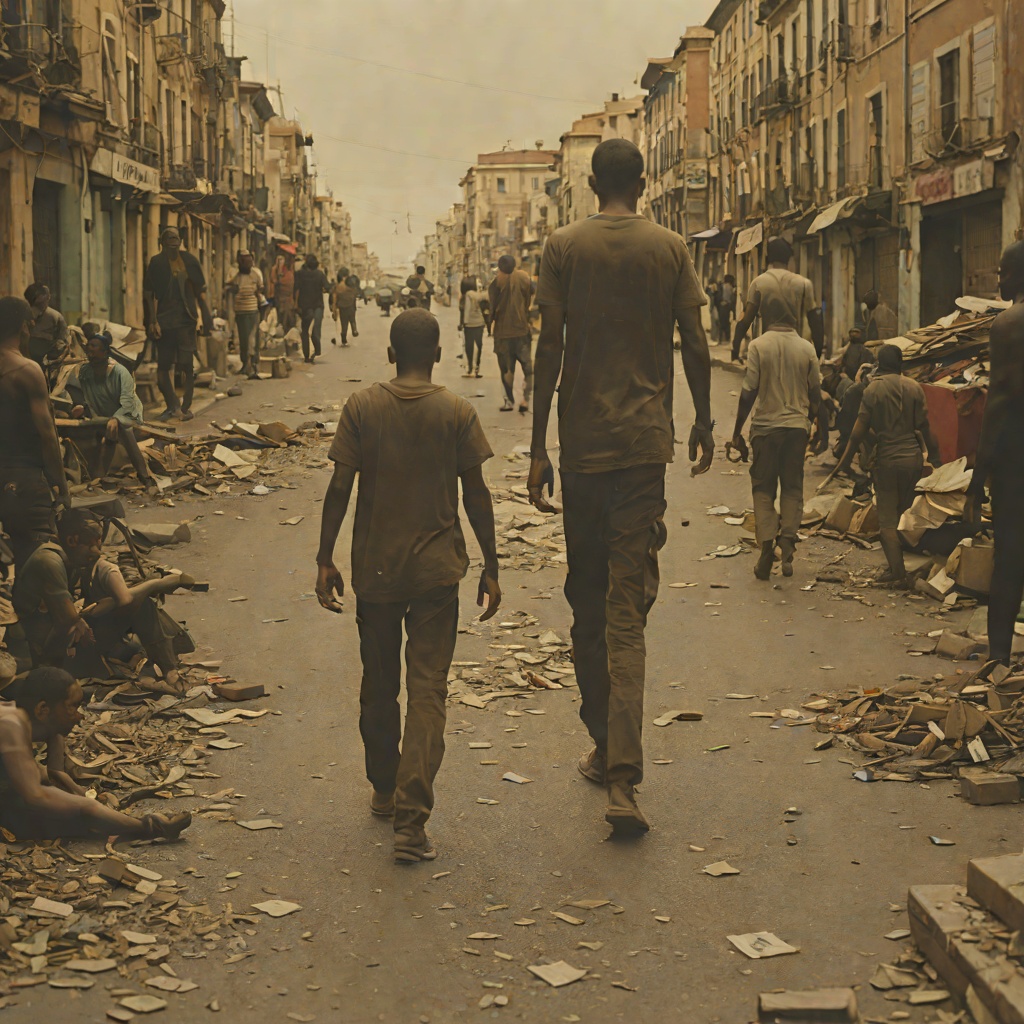
The clearest visual representation of the system occurs when the crowd divides itself into two groups while moving past the police cars. The middle- and upper-class spectators stand on one side of the road, near the marina and country club. Amelia Williams is among them, dressed for ordinary shopping and errands. Their clothing, grooming, and physical descriptions mark social security, but the narrative emphasizes what they lack: desperation. They appear incomplete because their bodies and minds are not occupied by the hunger, fear, and damaged hopes that shape the poor.
The poor occupy the opposite side. Their faces and bodies bear the visible effects of deprivation, including burst veins, sagging bodies, stringy hair, sores, and mouths described as blank or hanging. The police are more heavily deployed there, and additional officers keep arriving. The arrangement makes policing part of the geography of segregation: the side containing poverty is treated as the side requiring surveillance and force. The crowd is not merely observing a crisis; it is reproducing a social map in which wealth receives space and protection while poverty receives suspicion and control.
The contrast also exposes the ideological language used to contain class and racial conflict. The poor are imagined as potential thieves, vandals, gang members, and rioters, while the wealthy are protected as respectable citizens. The narrative’s boxing imagery turns this division into a public contest in which each group may be encouraged to fight in the cheaper seats while authority searches for a scapegoat. Racial segregation consequently works alongside class segregation: racial hostility offers a visible target for anger, and class power remains less visible behind the division.
Institutions of Exclusion
The same logic operates inside institutions that appear neutral. Ben Richards’s family faces medical insecurity so severe that Sheila Richards resists accepting government money for their sick child. Richards insists that the child needs a real doctor and modern equipment rather than a midwife working with dirty hands and whiskey breath. When Sheila refuses the proposed benefit as a bounty on her husband, Richards answers that she may have to accept a few oldbucks as the head of a fatherless household. Their argument reveals how poverty converts medical care, family survival, and state assistance into coercive choices. The family is formally offered help, but the help is attached to humiliation and political capture.
Food distribution produces a similar condition of managed deprivation. At the Boston Y.M.C.A., Richards and the other participants receive a standardized meal of cornflakes, greasy potatoes, scrambled eggs, hard toast, milk, coffee, sugar, salt, and fake butter. He eats quickly because it is his first substantial food in a long time, yet the meal tastes stripped of everything except brute nutrients. His desperation turns immediately toward money for the baby and toward the possibility that the promised reward may be only another government or Network trick. The scene shows how bodily need narrows formal freedom: a person who must secure food and medical care for a child is more vulnerable to an apparently voluntary bargain.
The Running Man intensifies that bargain by converting survival into entertainment. Dan Killian explains that a contestant or the contestant’s surviving family receives one hundred New Dollars for every hour of freedom, with forty-eight hundred dollars provided as running money on the assumption that the contestant can evade the Hunters for forty-eight hours. The contestant receives a twelve-hour head start, and thirty days brings a grand prize of one billion New Dollars. The rules sound precise and contractual, but their arithmetic makes desperation part of the program’s design. The state and the Network can call participation consent while poverty supplies the pressure that makes refusal nearly impossible.
Stigma, Surveillance, and Resistance
Racial segregation is reinforced by everyday speech as well as by formal institutions. At the Brant Hotel, a clerk watches a Black boy after the boy complains about losing a nickel, then uses the incident to justify racist contempt. The clerk says that Black people cannot be spoken to anymore and expresses a desire to keep them in cages. This exchange shows how a trivial dispute is enlarged into a theory of collective criminality. The boy’s poverty and anger are treated as proof of racial defect, while the clerk’s own hostility is presented as ordinary common sense.
Richards repeatedly survives by manipulating the visibility through which authorities and strangers classify him. After leaving Molie’s, he spends twelve hundred New Dollars on a disguise: gray hair, spectacles, mouth padding, plastic buck teeth, and a recommended limp. His wallet identifies him as John Griffen Springer, a forty-three-year-old widower and text-tape salesman from Harding. He later signs a hotel register as John Deegan from Michigan. These changing identities show that social identity is policed through appearance, documents, voice, occupation, and bodily performance. A man who can alter those signs may temporarily pass through hostile spaces, but the need to do so confirms the power of the classificatory system.
The Network’s institutional gaze is more severe still. In the Boston Y.M.C.A., the participants are processed through identification cards, a medical examination, and bulletproof elevator doors. A police officer repeatedly instructs them to move to the rear, while the elevator’s Judas hole remains empty and the men are transferred through a controlled interior. The procedure reduces bodies to numbers and transportable objects. Richards’s humiliation after the examination, including the lingering sensation of violation, makes surveillance physical rather than abstract.
At the same time, the system marks Richards as an anachronism. He is described as a dinosaur, a throwback, an embarrassment, and perhaps a danger, with the Network having calculated the invisible quality that sets him apart. His difference is not confined to race; it is produced by political obedience, economic usefulness, and the ability to fit the approved social type. The label of abnormality helps make repression appear reasonable. By contrast, Bradley’s reading and the gang’s homemade pollution counter represent a collective attempt to contest the official definition of what is normal, knowable, and worth protecting.
Anger, Policing, and Narrative Significance
Bradley warns Richards that people have been angry at white people for thirty years and need only one reason for that anger to erupt. His statement is neither a defense of indiscriminate violence nor a denial of its force. It identifies a reservoir of accumulated injury that public authority has failed to address and may exploit. The warning also foreshadows the way a society organized through racial separation can manufacture the conditions for unrest, then use the unrest as evidence that harsher control is necessary.
Richards’s own history shows how economic exclusion intensifies that process. After years of searching for work, he finds only miserable day and half-day jobs, including cleaning slime from beneath piers and in sump ditches. Eventually even those jobs disappear. When a wealthy drunk offers him ten New Dollars to expose himself for racist amusement, Richards knocks him down and runs. The episode places direct humiliation beside structural unemployment: the poor are denied dignified work, then offered money for submission, and punished or stigmatized when they reject the terms.
The final racial and institutional confrontation is embodied by Evan McCone, the Chief Hunter. McCone arrives with a bullhorn, announces his identity, and demands that Richards release Amelia Williams and surrender. His image is associated with the historical machinery of authoritarian policing, and his voice converts the crisis into an official command. The scene demonstrates how segregation’s violence is completed by the state’s power to name danger, surround it with armed personnel, and present force as protection for the public.
Racial segregation therefore functions throughout the novel as both an arrangement of bodies and a discipline of interpretation. It determines who is assumed to be desperate, criminal, ignorant, or dangerous; it limits access to care, knowledge, work, and safety; and it turns resentment among the dispossessed against other dispossessed people. Yet the same structure generates forms of resistance: Bradley’s improvised education, the gang’s pollution research, Richards’s refusal to accept humiliation without struggle, and his disguises expose the rules by which the social order recognizes and excludes people. The novel’s deepest criticism lies in showing that racial hostility is not an isolated prejudice but one of the visible surfaces of a system that makes poverty appear personal, makes surveillance appear necessary, and makes coerced choices look free.